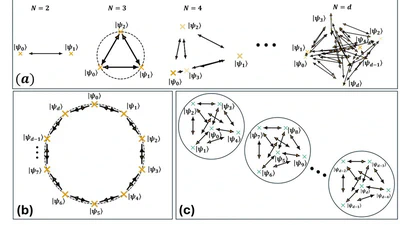
Reduced-state embedding for quantum cryptography
Encoding in a high-dimensional Hilbert space improves noise resilience in quantum information processing. This approach, however, may result in cross-mode coupling and detection …
amit-kam
Encoding in a high-dimensional Hilbert space improves noise resilience in quantum information processing. This approach, however, may result in cross-mode coupling and detection …
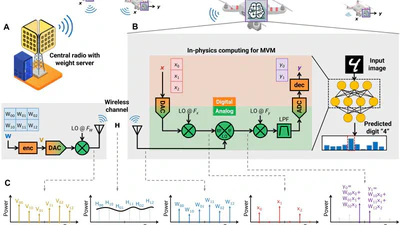
Modern edge devices, such as cameras, drones, and internet-of-things nodes, rely on machine learning to enable a wide range of intelligent applications. However, deploying machine …

Secure multiparty computation enables the joint evaluation of multivariate functions across distributed users while ensuring the privacy of their local inputs. This field has …
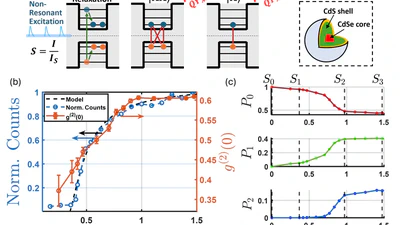
The original proposal of quantum key distribution (QKD) was based on ideal single photon sources, which 40 years later, are still challenging to develop. Therefore, the development …
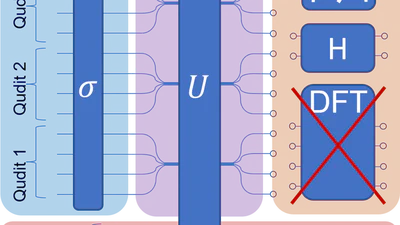
High-dimensional quantum key distribution (QKD) offers secure communication, with secure key rates that surpass those achievable by QKD protocols utilizing two-dimensional …
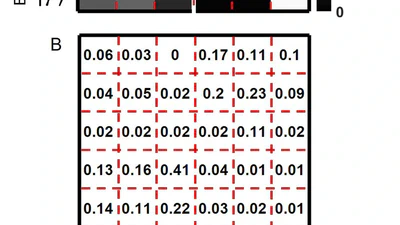
High-dimensional quantum key distribution (HDQKD) is a promising avenue to address the inherent limitations of basic QKD protocols. However, experimental realizations of HDQKD to …
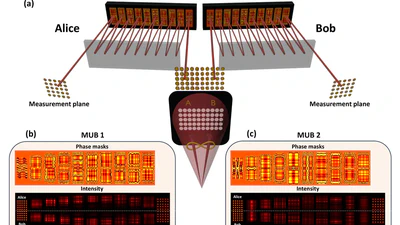
High-dimensional quantum key distribution (QKD) offers higher information capacity and stronger resilience to noise compared to its binary counterpart. However, these advantages …
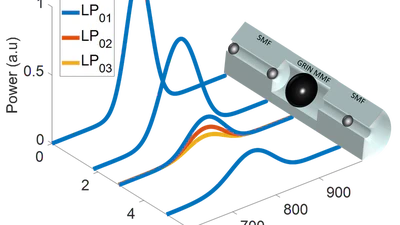
Multimode fiber-based saturable absorbers enable mode-locking in lasers, generating ultrafast pulses and providing an exceptional platform for investigating nonlinear phenomena. …
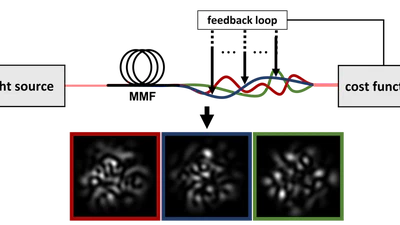
Multimode optical fibers support the dense, low-loss transmission of many spatial modes, making them attractive for technologies such as communications and imaging. However, …
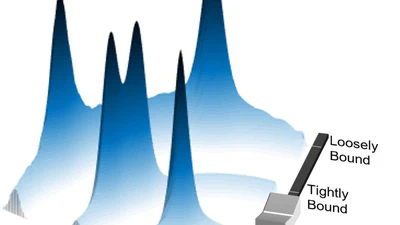
Multi-soliton mode-locked laser waveforms are much sought as a complex light source for research and applications, but are difficult to manipulate effectively because of the …