Quantum Cryptography and Autoformalization in Lean
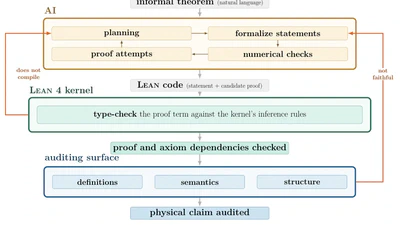
We formalized an end-to-end security proof of BB84 in the Lean proof assistant, down to the mathematical axioms: composable finite-key security of entanglement-based BB84 against …
•
1 min read

We secure information with quantum light, run AI directly in physics, and build AI that proves its own results.
Kfir Sulimany is an incoming Assistant Professor at the Technion’s Andrew and Erna Viterbi Faculty of Electrical & Computer Engineering, where he will establish the Quantum Machine Intelligence Lab. He currently leads the Quantum Perception team at MIT’s Research Laboratory of Electronics, working with Prof. Dirk Englund, and co-founded the Center for Verifiable AI at MIT-Technion. He received his PhD in Physics from the Hebrew University of Jerusalem under Prof. Yaron Bromberg. His research spans quantum cryptography, computing in physical hardware and machine-checked proofs.
PhD in Physics
2017
2023
Hebrew University of Jerusalem
MSc in Physics
2014
2017
Hebrew University of Jerusalem
BSc in Physics and Mathematics
2008
2011
Hebrew University of Jerusalem (Talpiot)
Diploma in Computer Science for BSc Graduates
2013
2016
Open University of Israel
New paper: Quantum Cryptography and Autoformalization in Lean. An end-to-end, machine-checked security proof of BB84 in Lean, down to the mathematical axioms, built with LLM-based autoformalization. Read more →
Quantum cryptography, secure computation, and quantum machine learning on integrated photonic platforms. Deep learning with quantum-bounded leakage of client data and model weights (Phys. Rev. X, 2025).
Learn more →Data centers for AI consume a growing share of the world's electricity. We build optical and RF neural networks that perform AI directly in the physical domain at a fraction of the energy (Science Advances, 2026), and study the fundamental limits of computation.
Learn more →We build AI whose scientific conclusions are checked by a proof assistant. Our team recently produced a Lean-verified proof of the decade-old FGG quantum-optimization conjecture (led by Uri Kol) and an end-to-end machine-checked security proof of BB84 (led by Maor Ben-Shahar), and we co-founded the Center for Verifiable AI at MIT-Technion.
Learn more →We formalized an end-to-end security proof of BB84 in the Lean proof assistant, down to the mathematical axioms: composable finite-key security of entanglement-based BB84 against …
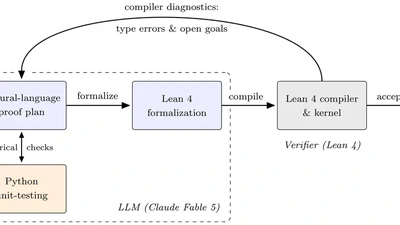
We resolved the Farhi–Goldstone–Gutmann conjecture on the optimal performance of QAOA on the ring of disagrees, open since 2014. The proof was proposed by a large language model …
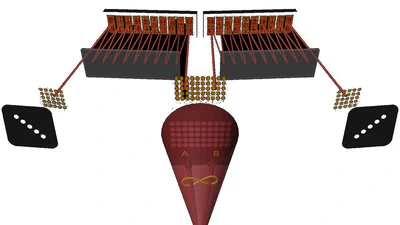
Our paper on reduced-state embedding for quantum cryptography, which builds error correction into the choice of high-dimensional QKD states, is published in Newton.
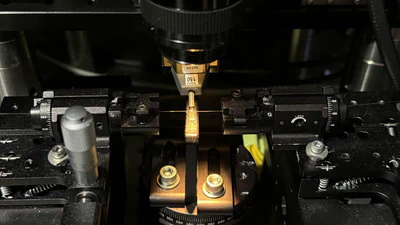
Popular-science feature (in Hebrew) on our quantum-secured AI work — using quantum optics to guarantee privacy in cloud-based AI computation. בינה מלאכותית מאובטחת קוונטית.

Our paper on disaggregated machine learning via in-physics computing at radio frequency is published in Science Advances.